What Do We Teach Children About Violence and War?
“Since the end of human action [...] can never be reliably predicted, the means used to achieve political goals are more often than not of greater relevance to the future world than the intended goals.”
—Hannah Arendt, On Violence
In my first year of PhD studies in Education, I was observing a kindergarten teacher manage the serious politicking taking place among five-year-olds. They had to color pictures of things that began with an F — and firetruck was the jewel of the bunch.
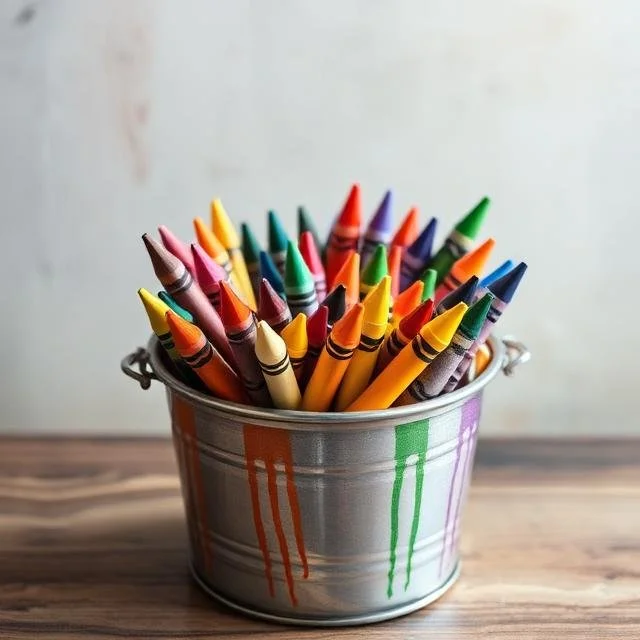
In order to complete their assignments, four students around a circular table reached for the bucket of crayons, and there was only a single red crayon.
I then watched some cherubic-looking children become absolutely feral over who would get the crayon, and it led the teacher to come over for a necessary lesson in diplomacy.
“We can share the crayon. Everyone will get a turn,” she said. She even managed to borrow an extra red crayon from another table, and thus she avoided a series of crayola-related homicides that Tuesday morning.
If I had asked about the beliefs underscoring her actions, I imagine her response would be similar to those of many people: 1) it’s important to learn to share, and 2) it’s important to not use violence to solve your problems.
Ah, violence, that tricky word that some use to refer to the act of making and consuming a bacon cheeseburger, all the way to the dropping of an atomic bomb.
Curbing violence is a massive effort in K-12 education — there are schools that automatically suspend students who get into a physical fight, and there are even some schools where the police are involved in managing these altercations.
I think I would agree with most that schools should make an effort to expand a student’s conflict resolution toolkit to involve more than just punching someone you have a problem with. It’s a laudable effort, and I think Hannah Arendt would think so, too. As the opening quote suggests, she would have much to say about how we teach those things, but she’d concede that it’s a worthwhile effort.
But there’s something bewilderingly different between what we aim to teach students about violence in K-12 schools compared to what they learn as they witness the violence of war. I am uninterested in discussing when war and its violence might be unavoidable or even honorable; rather, the contours of what is explicitly avoidable and dishonorable are my concern here.
Casualties in war.
Nothing casual about them.
There’s a paid adult with a couple of college degrees that will keep a five-year-old from biting another over a red crayon.
And then I imagine there’s a room full of adults deciding how many people they’re okay with killing that aren’t even soldiers so they could have control of the entire bucket and all of the red crayons in it. They’ll invade Venezuela and kidnap to have all the oil crayons. They’ll bomb schoolchildren in Iran, and the President will rapid-fire made-up reasons for having done so, while some just assume they also want control of the bucket and oil crayons there, too.
Casualties — it’s tough to find a joke in them, in the same way that it’s hard to not wake up thinking about the acts of violence national leaders are willing to commit in our name.
I’m not sure where the reading crowd lands on Bill Burr, but through his stand-up comic he sometimes has insightful things to say about the world. There’s this bit he does about war between Israel and Palestine:
“[...] This is my favorite response, well they’re using kids as human shields! It’s like well, you gotta work around that! Jesus Christ! If I’m mad at my neighbor, and I wanna beat the shit out of him, but he’s holding a baby, right, I wouldn’t come in and try to punch him through the baby.”
It’s silly, but there’s an earnestness there worth pausing for. In Iran, the US military murdered students at a school as they attempted to attack an adjacent military compound. Of course some could argue that there are inevitably going to be casualties in war, and unfortunately this is an example. And some argue exactly this. But another position — a more reasonable one, I’d insist — is that maybe you just don’t get to drop bombs on a base and kill children in a school because you want control of the bucket and all its oil crayons.
If the US was attacked in a war and a bomb dropped on a school full of children, everyone would and should be justifiably outraged.
But what are we teaching kids about the violent acts we rationalize away in war? That kindergarten rules are out the window? That murder can be reduced to unavoidable casualties as long as it happens to someone else? Is it really as simple as that? If it is, doesn’t that say something much deeper about how the means we use to achieve political goals — regardless of the ends — reflect something so tragically monstrous about ourselves?
There is something profoundly absurd about what we explicitly teach children regarding violence compared to the implicit lessons learned if one reflects on the violence of war.
What to do about this?
One response in the face of the absurd is an equally absurdist reply. Dadaists and their anti-war and anti-seriousness efforts are an interesting recourse (check out this substack piece by The Archaic Allegory on the topic). I don’t know that I’m as far as over as the Dadaists on the spectrum of lack of faith and hopelessness — at least not at this moment — but let me leave you with a poem inspired by a sense of the absurd.
War.
Children.
Use Your Words.
Share the red crayon.
Adults.
Drop your bombs.
Kill for all the crayons.